BUSINESS & COMMERCE
E-bike charging station for your business.
Eight charging stations, one parking space.
An employee benefit you can plan for.
Why an E-Bike Charging Station?
Employees commute by electric vehicle.
Your parking space is still charging combustion-engine vehicles.
Commuter transportation is going electric, and company bicycles are being leased.
What starts out as a benefit will determine whether employees stay tomorrow.
A store where people work
Commuters set off for home with a full charge. No need to bring a cable from home, no need to search for one on the way. The company bike becomes your everyday mode of transportation.
In your branding
Stations can be customized with your branding upon request. A location feature that makes an impact.
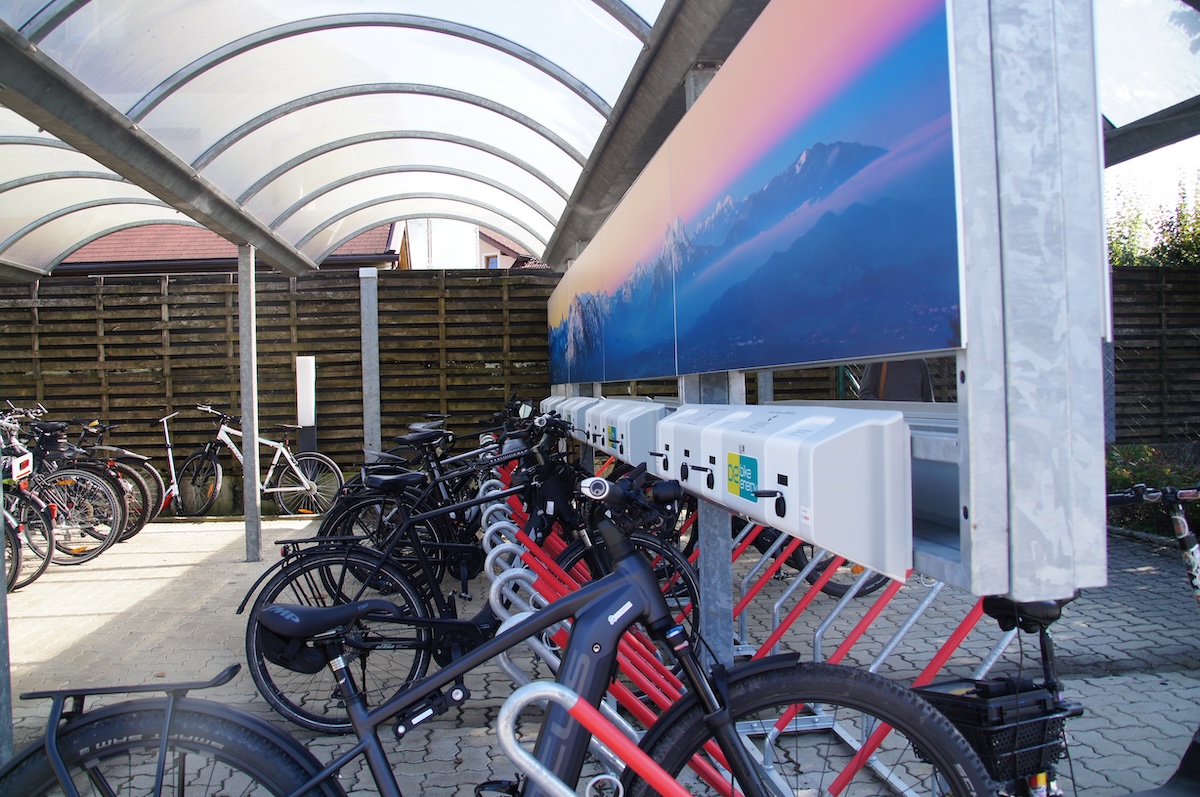
One parking space eight e-bikes
Where a car would normally park, at least eight e-bikes are charging at the same time—in an eco-friendly way.
See how much is being loaded
With CONNECT, charging stations are managed centrally. Usage, utilization, access, and more. All at a glance.
Even the best benefit is useless if it can't charge.
The company bike has been paid for, and the employee is on board.
If there is no charging station at the location, the investment will be ineffective and the benefit will remain merely a promise.
A parking space is being turned into a charging hub for employees.
Designed for outdoor use—sturdy construction, permanently installed, and weather-resistant. At least eight e-bikes can be charged where a car used to park.
Every employee can find their cable.
Over thirty cable options cover all common drive systems. You can selectively grant access to determine which users can charge at your station.
The location, centrally managed.
One portal, all stations. Usage, access, and utilization can be tracked at any time. The basis for reporting and billing.
LOCATIONS IN OPERATION
Companies that are already charging today.
Different industries, same requirement.
A system that runs reliably in everyday use.
How to Get Started
That's how a parking lot becomes a charging station.
1
Needs Assessment
We analyze your region: visitor traffic, bike paths, existing infrastructure, and location potential. You’ll receive a clear recommendation regarding the number and placement of stations.
2
Technical Planning
Each station requires 230V household power. We assess what is feasible at each location and plan the configuration: station type, charging bays, installation, and branding.
3
Funding opportunities
bike-energy charging systems are recognized under many funding programs for sustainable mobility and KEM projects. Check with your regional funding agency for information on current programs.
4
Installation and commissioning
Delivered fully assembled, installed, and connected. Your region is now visible on the bike-energy network.
Ready for your charging system?
Let us advise you without obligation and we will find the right station for your location.
Frequently asked questions
A bike-energy e-bike charging station requires only a standard 230V outlet—just like a regular electrical outlet. Electric car charging stations require a 400V power supply. Since all charging stations are delivered fully pre-assembled, no special installations or additional wiring are necessary. The connection should be made by an electrician.
Yes, bike-energy charging stations are eligible for funding in many regions—at the federal, state, and municipal levels. Funding is available, among other things, through active mobility programs, klimaAktiv initiatives, and municipal tourism projects.
The installation effort for a bike-energy charging station is minimal—all you need is a 230V outlet. All stations are delivered fully pre-assembled and, thanks to optional stands (POINT & LINE models) or a base plate (TOWER model), can be set up freestanding without requiring a foundation. In most cases, no structural preparations, excavation work, or special fixtures are necessary. The electrical connection must be performed by a qualified contractor.
Yes, all bike-energy charging stations are fully weatherproof and built to be vandal-resistant. They are "Made in Austria" using high-quality materials and are TÜV-tested, CE-compliant, and ISO 9001 certified. Charging can be done safely in any weather—rain, snow, or heat. This robust design has proven itself since 2011 across more than 3,000 installed stations in 19 countries.
Yes, multiple bike-energy charging stations can be easily connected to form a regional network—both technically via bike-energy CONNECT and through the bike-energy app. This creates a comprehensive e-bike charging infrastructure that guides visitors through the region and connects tourism businesses with one another. Through online monitoring, operators can centrally manage all locations, analyze charging activity, and deploy OTA updates. Ideal for tourism regions, cities, and mountain rail networks.
Yes. Depending on the model, a station has 2 to 5 charging points where e-bikes can charge simultaneously and independently of one another. Over 30 different cable types cover the most common e-bike brands. The number of charging points is specified when placing the order. If the location later needs more charging spots, an additional station can be added.
Fire hazards at bike-energy charging stations are reliably prevented by intelligent charging electronics with multiple safety shut-off mechanisms. The charging cables (depending on the manufacturer) communicate with the station via an integrated data storage device (EEPROM)—current flows only once the voltage and battery type have been correctly detected. If values fall outside the safe range, the system shuts down immediately. Unlike charging with private home chargers plugged into unprotected outlets, bike-energy offers a certified, TÜV-tested safety concept.
Implementing a regional charging infrastructure typically takes between 3 and 12 weeks—depending on the number of locations and the equipment. Delivery of a single charging station takes up to 3 weeks, depending on the configuration and custom wrapping. From consultation to site planning, for larger regional projects, we’re happy to create a detailed timeline—contact us for a no-obligation quote.
